Morocco is a lively place to learn Arabic because the language leaves the classroom with you. Darija appears in greetings, cafés, markets, taxis and family conversation; Modern Standard Arabic appears in formal study, writing and media. Your best city depends on how long you have and which kind of Arabic you want.
Choose your city
| City |
Best fit |
Learning character |
| Fes |
Intensive MSA or Darija with deep cultural context |
Strong academic options plus medina, craft and food immersion |
| Rabat |
Longer structured study and capital-city life |
Good for formal programmes, private lessons and repeat stays |
| Tetouan |
Northern Morocco and focused school study |
MSA, Darija and a multilingual Andalusian-Moroccan setting |
| Tangier |
Short or flexible study in a multilingual city |
Darija alongside strong French and Spanish presence |
| Marrakech |
Practical taster around a wider holiday |
Useful phrases and cultural introduction; verify teaching depth |
| Chefchaouen |
Private or community-scale introduction |
Small-town practice, with fewer structured-school choices |
Darija for daily Morocco
Darija is the spoken language you will hear most in everyday Moroccan Arabic conversation. It varies by region and speaker. A beginner course should teach useful exchanges, listening and pronunciation—not only transliterated phrase lists.
Start with greetings, polite questions, numbers, directions, food and simple social language. Ask whether the course teaches Arabic script, Latin transliteration or both. Transliteration can help you begin quickly; script gives you a stronger long-term foundation.
MSA for wider Arabic study
Modern Standard Arabic supports formal reading, writing and communication across countries. It uses more structured grammar and vocabulary than a short visitor Darija course. If you plan to continue Arabic after Morocco, MSA may deserve most of your classroom time.
Combining MSA and Darija works best when the school explains the role of each. Beginners can become confused if vocabulary is mixed without labels. Ask for a timetable and separate outcomes.
How much can you learn?
A two-hour session may improve pronunciation and give you a small set of phrases. One intensive week can build routine and confidence. Three to six weeks gives time for repetition, assessment and a more useful listening base.
Count teacher-led hours, not simply nights in Morocco. Ask about homework, class size, level placement and whether cultural activities include an actual language task. Mint tea is excellent for conversation; it is not automatically a contact hour.
Make the city your practice space
A language-learning holiday becomes stronger when practice is respectful and purposeful. Use the market to ask a price or name ingredients; use a craft session to learn materials and tools; use a cooking class to practise actions and taste vocabulary.
Do not treat every Moroccan as an unpaid tutor. Ask before launching into exercises, accept that people may answer in French or English, and thank anyone who gives you time. Your teacher can help you prepare small real-world tasks.
Accommodation and cultural activities
Homestays, riads, apartments and student residences offer different levels of contact. A homestay can add daily listening but needs clear expectations, privacy and consent. Ask which meals are shared, which language the household normally uses and whether “immersion” includes structured support.
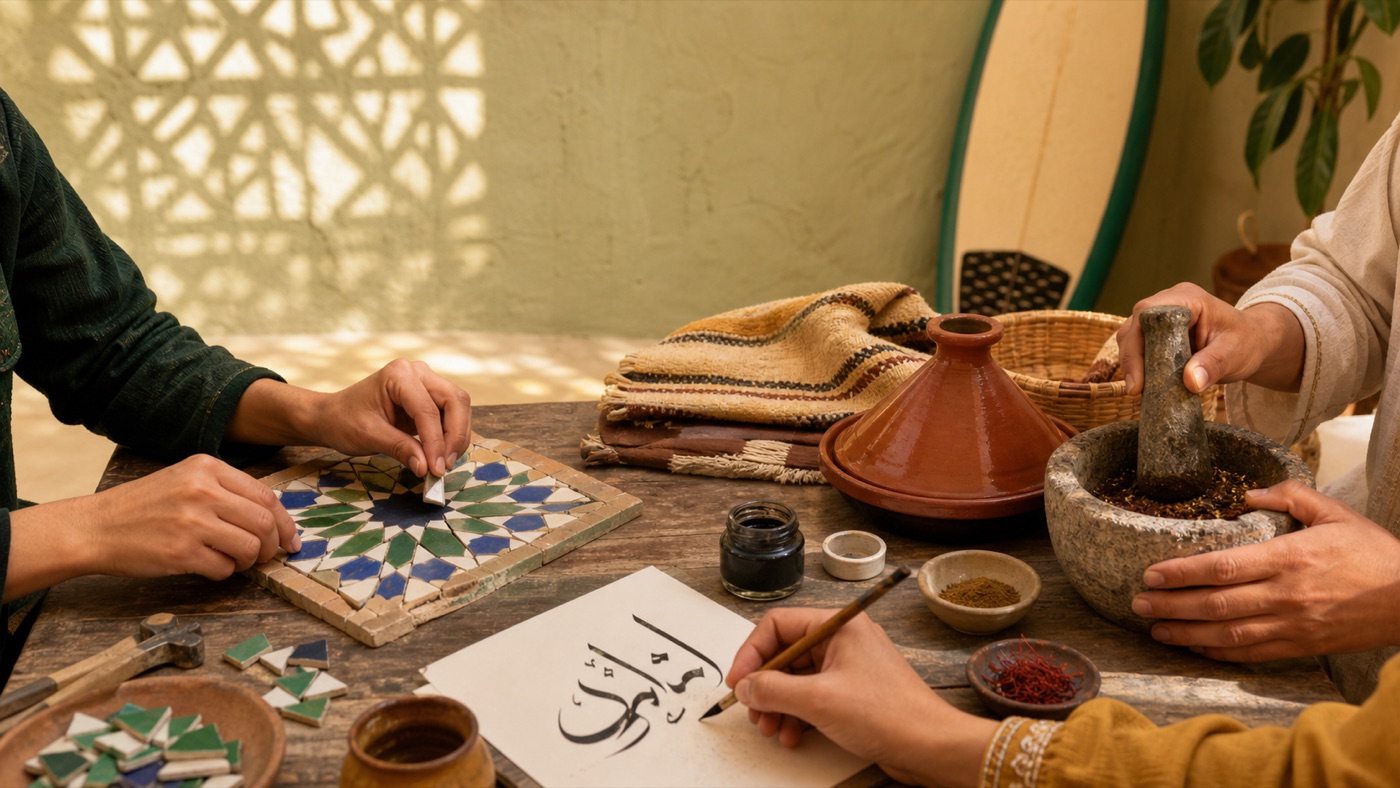
Cultural activities may include calligraphy, cooking or guided visits. Choose those that create meaningful language use. Pair Arabic with calligraphy in Fes, Fes cooking or the complete Morocco learning hub.
Questions worth sending
- Which variety of Arabic is taught?
- How are MSA and Darija separated?
- What level placement happens before arrival?
- How many teacher-led hours are included?
- What is the class size at my level?
- Which script and transliteration system are used?
- Are materials, homework and assessment included?
- Who teaches and in which support language?
- What accommodation and cultural activities are included?
- Is the complete programme alcohol-free?
Enquire with the useful details
Tell GoLearnTo your dates, current level, past study, preferred city, MSA-versus-Darija goal and available hours. Add your accommodation preference and any craft, cooking or calligraphy interest. We can then help you choose a serious course—or a cheerful taster that admits it is a taster.
 Editorial contextLearn in Chefchaouen, Morocco