Imlil is a village and trailhead, not shorthand for every High Atlas route. First ask where the learning happens. Is it inside the village, across the valley or on a mountain route? Altitude, exposure and emergency needs change the activity completely.
Imlil qualifies for four learning routes. Four direct propositions appear as transparent research profiles, not verified recommendations. Mule rides and casual summit products are excluded from inventory while welfare and high-mountain controls remain unresolved.
Choose your Imlil learning route
| If you want to… |
Start with |
Evidence to request |
| Learn to move through mountain terrain |
Guided walking |
Exact route, ascent, guide, pace and turnaround |
| Develop higher-mountain judgement |
Mountain skills |
Season, guide credential, practice, equipment and rescue |
| Reproduce a local cooking method |
Cooking |
Village, cook, active stages, correction and food controls |
| Understand a changing village landscape |
Field learning |
Guide, resident consent, water, tourism and benefit evidence |
Village → valley → mountain
Imlil owns village-based learning and routes explicitly beginning there. Aït Souka, Mzik, Tamatert and Aroumd/Armed must be named when a route reaches them. The Mizane Valley, Toubkal National Park, refuges and Jbel Toubkal progressively increase distance, altitude and risk.
A village stroll, valley walk and summit attempt are different products. An Imlil pickup does not make a multi-day High Atlas itinerary an Imlil lesson.
Path → pace → proof
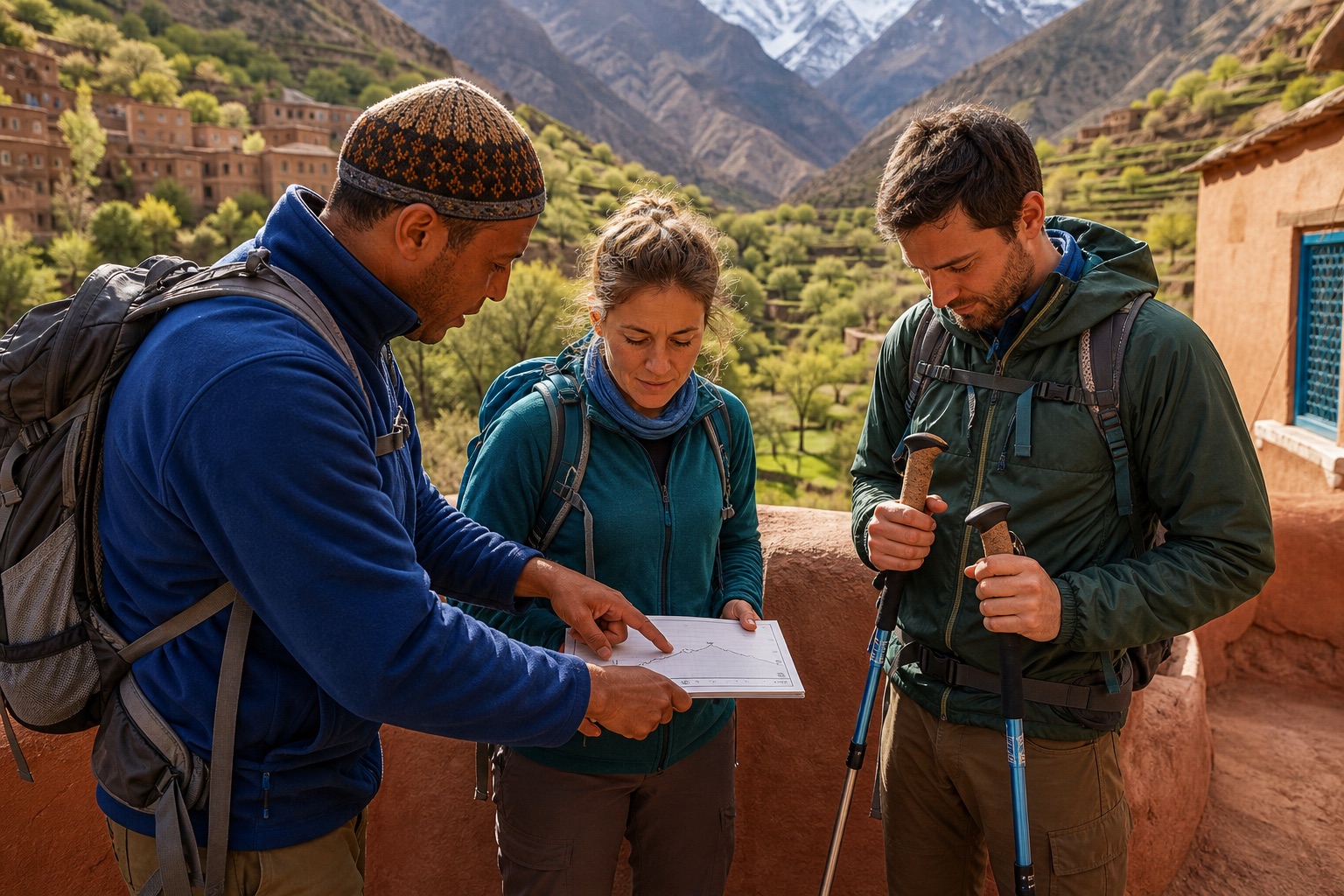
A learning walk should teach route reading, terrain, pace, water, weather and turnaround decisions. The learner should apply the method under supervision and explain the decision back—not merely follow a guide to a viewpoint.
Every profile needs exact start and finish, distance, ascent and descent, surface, exposure, current conditions, group ratio, first aid, communications, evacuation and insurance. Fixed hours without the route profile are not a grade.
Guide competence is route-specific
The Bureau des Guides Imlil publishes CFAMM training for its guides, making it the strongest local credential lead. An individual assignment still needs diploma or credential confirmation, relevant seasonal competence and a route-specific emergency plan.
Commercial sources describe guide checks on Toubkal routes, but this research did not recover the current rule from a Moroccan authority. The site therefore does not publish an unverified legal requirement.
Mountain skills are not summit instructions
Imlil clearly qualifies for mountain-skill learning, but the page must not teach unsupervised summiting, winter travel or altitude medicine. A course should match terrain and season, demonstrate equipment and movement, supervise practice, correct decisions and set conservative limits.
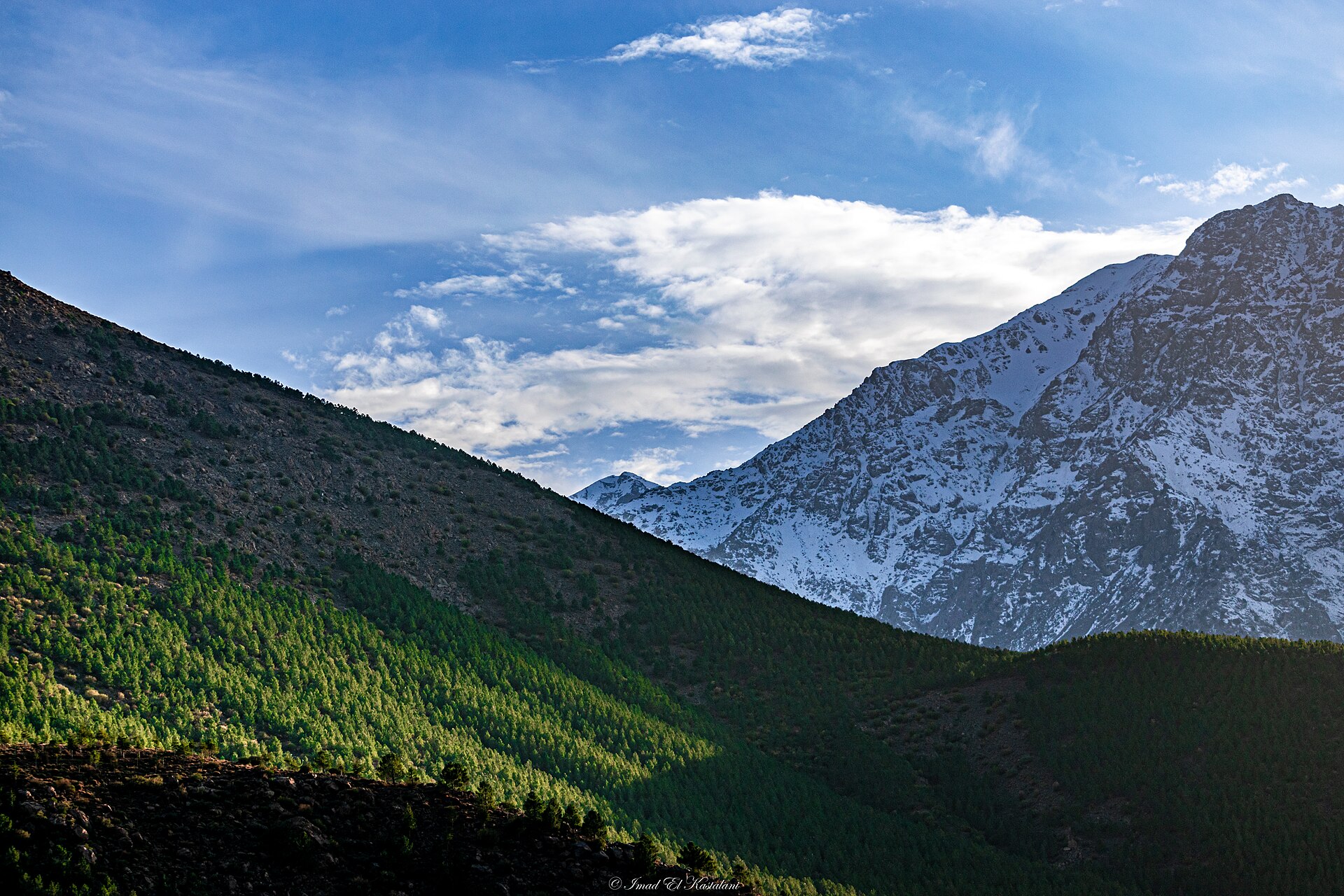
Snow, heat and storm risk change sharply with elevation. Winter mountaineering is not ordinary hiking. Any Toubkal attempt requires separate route, acclimatisation, refuge, guide, equipment, forecast and rescue verification.
Imlil’s terraces, orchards, streams and paths are parts of an inhabited working landscape. A good field route connects land use, water, movement and tourism change without treating residents as scenery or entering homes by assumption.
Research documents both tourism income and pressure on traffic, infrastructure, waste and water. The learner should observe systems and trade-offs, not receive a simplified “traditional village” story.
Cooking has the clearest non-mountain practice
Authentic Toubkal Lodge publishes start-to-finish family cookery with ingredients, tagine and bread. Dar Assarou publishes a hands-on small-group format with at least two dishes. Both create credible learning signals.
Neither source completes the exact village, assigned cook, active preparation time, correction, food controls, accessibility, insurance or direct-benefit evidence. Each remains a research profile on HOLD.
A home is not included by default
“Local family” and “hospitality” do not grant access. A cooking or village experience must identify the host, secure consent, disclose compensation and set photography and privacy boundaries.
The kitchen, ingredients and inclusions must be explicitly alcohol-free. Ask about allergens, cross-contact, handwashing, charcoal or flame, ventilation, knives, children and mobility.
Load → tack → care
Peer-reviewed research on working mules in the Toubkal massif found tethering, bitting and hoof concerns among surveyed animals. That makes welfare a core selection test, not a decorative ethics note.
Any mule-supported product must disclose the owner, handler, workload and rider or load limit. It should cover body and hoof condition, tack, rest, water, feed and shade. Injury response, veterinary access and payment must also be clear. “Sure-footed,” “local” or “traditional” proves none of this.
No mule ride is shown as a provider card. A walking alternative must remain available, and luggage support cannot be assumed welfare-compliant.
The Association des Bassins d’Imlil and a claimed five-percent Kasbah surcharge are documented. That does not prove every provider contributes or that every “community” experience shares decisions and income.
Ask which organisation receives funds, how much, for which work and who reports the result. Earthquake rebuilding can be discussed only with current evidence and resident dignity, never as a charity spectacle.
What does not qualify here
Photography and yoga appear in generic destination copy but lack grounded Imlil teachers and formats in this evidence set. A meal is not a cooking class. A waterfall mention is not a verified universal route. Mule riding is not animal-handling tuition. Summit packages are not casual city cards.
Return to Morocco, compare the wider Atlas Mountains, read guided walking, or review travel insurance questions.
Enquire with the useful details
Tell GoLearnTo the route or skill, dates, starting fitness or experience, group, preferred language and access, medical or dietary needs. An enquiry requests verification or an introduction; it does not confirm booking, conditions, safety or suitability.
Evidence
Selected references
Official and institutional references used for place, heritage or practical context. Commercial operators and marketplaces are kept in our private research ledger rather than promoted here. Reviewed 14 August 2026.
- Moroccan National Tourist Office
- UK Government travel advice

 Editorial contextLearn in Imlil, Morocco