Skip to content
GGoLearnToTravel home with a skill

commercial spoke

Thuya woodwork and marquetry in Essaouira

Understand Essaouira thuya marquetry by material provenance, process stages, safe learner action and the boundary between an atelier visit and class.

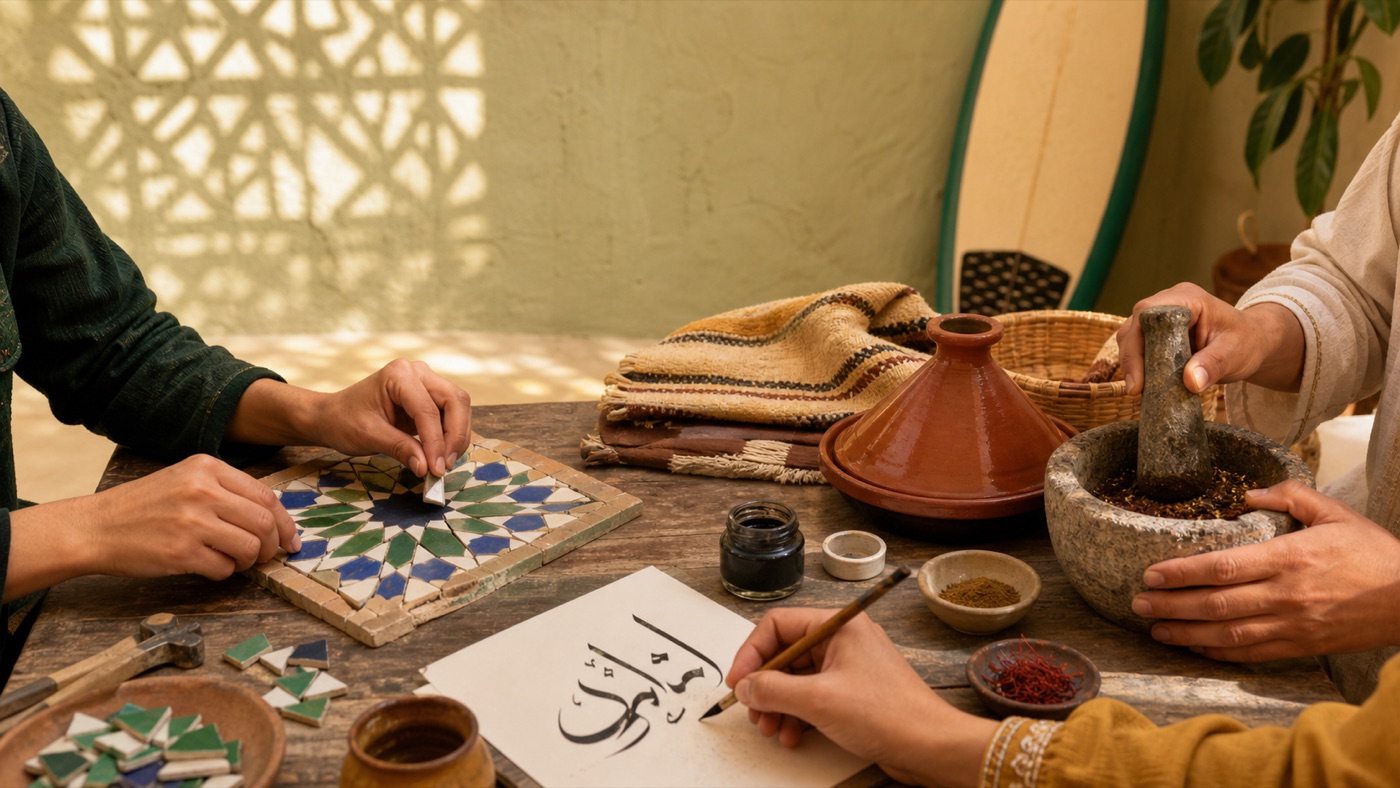
Editorial illustration of hands learning zellige, calligraphy and Moroccan cooking techniques
Editorial context · AI-generated editorial context image by GoLearnTo

Salam from Essaouira

Why the place matters

Essaouira lets wind, rhythm and the Atlantic set the pace. A good plan leaves room for all three.

A Moroccan minute

Meet the material before chasing the souvenir. Good hands-on work makes the tools and maker visible.

Useful first. Memorable second. Ideally both.

Place–skill evidence

Why this skill belongs in Essaouira

Understand the long marquetry chain and identify which safe stage a visitor actually performs rather than mislabelling an observation visit as a class.

thuyaTetraclinis articulatamarquetry
Open the complete place hub
Provider evidence
HOLD
Sources checked
2
Last reviewed
14 Aug 2026

Other qualified skills in this place

Same placeSurfingLearn through a condition-matched progression from briefing and board handling to coached attempts, with active water time separated from booking time.Explore on GoLearnTo Same placeKitesurfingTreat kite control as its own staged discipline, with instructor ratio, equipment, wind threshold and unsuitable-condition policy made explicit.Explore on GoLearnTo Same placeWindsurfingCompare rig handling, balance and coached sailing time without assuming that a windy destination gives every beginner suitable conditions.Explore on GoLearnTo Same placeWingfoilSeparate wing handling, board control and later foil progression so a beginner knows which stage the purchased lesson actually covers.Explore on GoLearnTo Same placeGnawa guembri initiationApproach guembri as a bounded musical and cultural initiation with a named practitioner, respectful repertoire boundary and corrected first rhythm.Explore on GoLearnTo Same placeGnawa dance and krakebsLearn a defined movement and rhythm sequence while distinguishing participatory teaching from festival performance or ritual reenactment.Explore on GoLearnTo Same placeMoroccan embroideryPractise stem, satin and chain stitch in a corrected sequence, with practitioner identity, kit, stitch time and retained piece clearly stated.Explore on GoLearnTo Same placeMoroccan cookingConnect market choices with hands-on preparation, seasoning and a repeatable dish while keeping food controls and home-setting consent visible.Explore on GoLearnTo

Your learning plan

What a good thuya woodwork and marquetry experience in Essaouira should feel like

Try one bounded craft process properly, with the person, tools and safety behind it kept visible.

The honest outcome

A small piece or practice sample when feasible, and enough understanding to describe who made what.

01

What you should practise

  • Read the material and tool
  • Make or decorate a controlled piece
  • Correct the technique and finish safely

02

A sensible session

  1. Practitioner-led demonstration
  2. Supervised making
  3. Finish, care and attribution

03

Compare before enquiring

  • Named craftsperson
  • Hands-on share of the process
  • Tool, material and transport safety

A little Moroccan honesty

A retail stop, factory visit or artisan demonstration should never be relabelled as a workshop simply because a traveller is holding a tool for a photograph.

Local signals

thuya · Tetraclinis articulata · marquetry

The place–skill fit is evidenced; provider verification is still open.

Thuya marquetry is strongly associated with Essaouira, but most visitor access is observation or retail. A researched one-hour atelier visit describes watching selection, shaping, carving, sanding and inlay. That can be valuable interpretation; it is not automatically a woodworking class.

The object-completion chain

Thuya work may involve material selection, drying, shaping, carving, inlay, sanding and polishing. A short class must select a safe, meaningful stage rather than imply that the learner completes the whole chain.

Visitor role Honest description
Watches several stages Atelier visit or demonstration
Handles samples and asks questions Material interpretation
Tries one supervised stage Sampled participation
Repeats and corrects a bounded process Practical workshop

Why no provider is shown

The skill qualifies from Essaouira’s material and workshop evidence, but no researched direct operator currently proves a complete visitor learning loop. Marketplace “hands-on” language is insufficient without the practitioner, tools, safety controls and exact learner action.

What to verify

  • Direct workshop and current named practitioner
  • Material species and provenance documentation
  • Which stage the learner performs and repeats
  • Blade, dust, ventilation, eye and hand controls
  • Prepared parts and later finishing
  • Practitioner consent, attribution and compensation
  • Accessibility, safeguarding and alcohol-free setting
  • Current duration, group size, price and cancellation terms

Return to the Essaouira map, compare embroidery, or choose painting for a lower-tool creative practice.

Continue on GoLearnTo

Related places, skills and field guides

Keep exploring

More places and learning ideas