Aït Benhaddou is a ksar: a collective fortified settlement, not one giant kasbah and not a purpose-built film set. Its strongest learning experiences explain how settlement, earth, water, maintenance and community stewardship fit together—or teach a practical skill in a clearly identified modern kitchen.
Aït Benhaddou qualifies for five learning routes. Three direct or locally grounded propositions appear as research profiles, not verified recommendations. Photography remains on provider HOLD.
Choose your Aït Benhaddou learning route
| If you want to… |
Start with |
Evidence to request |
| Reproduce a local food technique |
Cooking |
Teacher, kitchen, active stages and food controls |
| Read how earth behaves |
Architecture |
Guide, material method, public route and conservation limits |
| Understand the collective settlement |
History |
Sources, resident context, stewardship and benefit |
| Learn through a careful route |
Walking |
Crossing, terrain, permissions, observation and heat plan |
| Build a visual sequence responsibly |
Photography |
Local teacher, assignment, consent and critique |
Photography has a qualified subject but no locally based short-format provider that passes the teacher, assignment, permission and review checks.
Ksar, not kasbah
UNESCO defines the property as a group of earthen buildings enclosed by defensive walls. Individual fortified houses or towers may be called kasbahs; the entire ensemble is the ksar. This is not pedantry. It changes what the learner looks for: collective dwellings, circulation, shared structures, defences and adaptation rather than one palace.
Film recognition can help orientation, but it should not become the page’s organising idea. The settlement existed for community life and historic movement long before modern screen production.
Old → river → modern
The old ksar and modern settlement are distinct but connected. The Oued El Maleh and current crossing or footbridge conditions shape access. Ouarzazate is a separate city, while Telouet and the wider Ounila route extend beyond this hub.
Profiles must name the real kitchen, meeting point and route. A pickup in Ouarzazate does not make a regional circuit an Aït Benhaddou class, and a viewpoint does not grant access to homes or roofs.
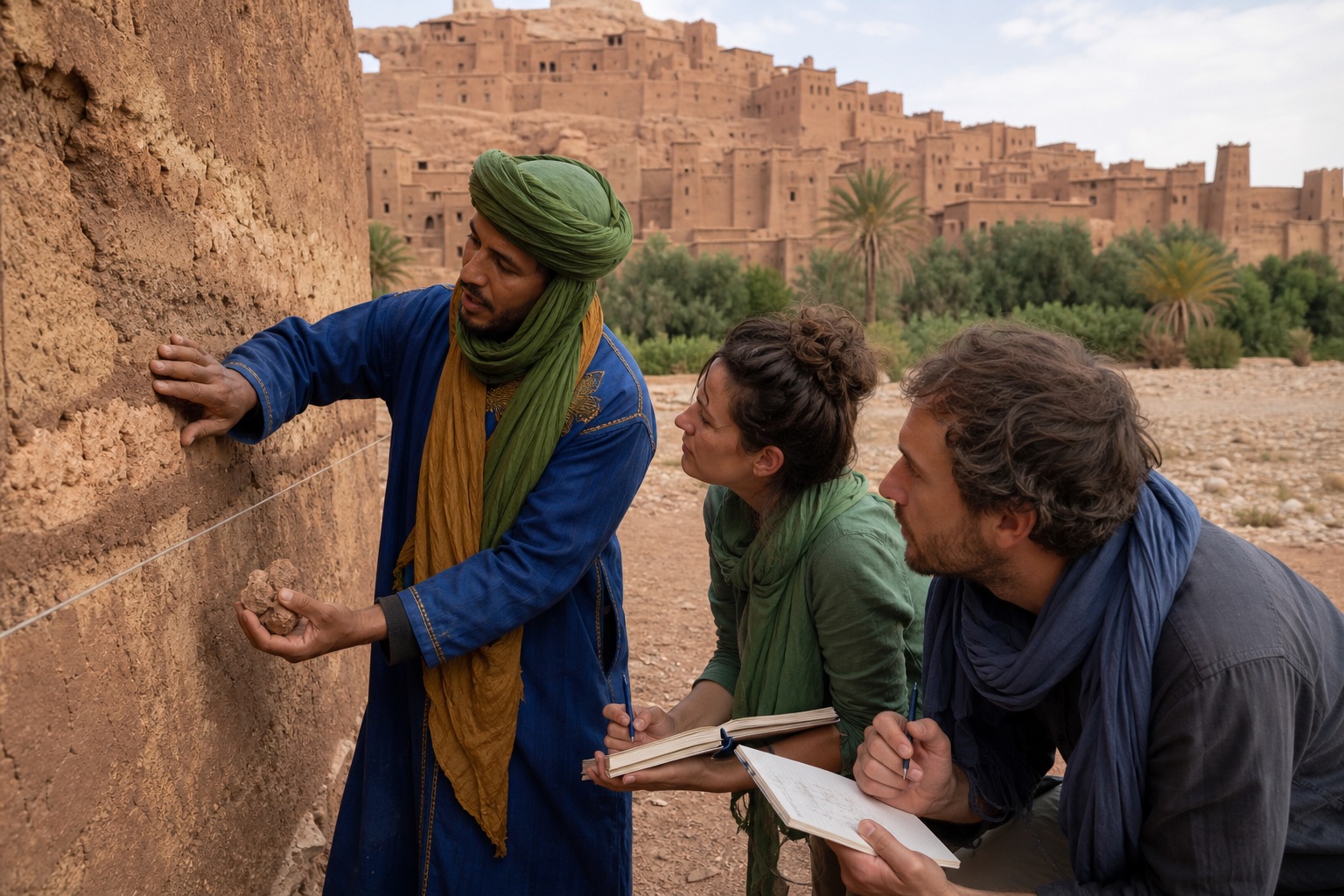
Earthen architecture is a maintenance system rather than a permanently stable object. Wall surfaces, drainage, erosion, repairs and abandonment reveal how material, climate and stewardship interact. Post-earthquake assessments add a current conservation layer.
A visitor can learn to observe these systems without touching protected fabric. Current evidence does not establish a permitted mud-brick or restoration workshop, so none is listed. Conservation documentation is not permission to enter a work zone or practise repair.
Look → locate → learn
A strong guide asks the learner to notice a feature, place it inside the settlement system and explain what it changes. A tower, opening, surface repair or communal space becomes meaningful through comparison and evidence rather than a stream of film titles.
The same method works for history: identify the feature, connect it to circulation, defence, domestic life or stewardship, then state what is known and what remains interpretation.
Cooking is the clearest hands-on route
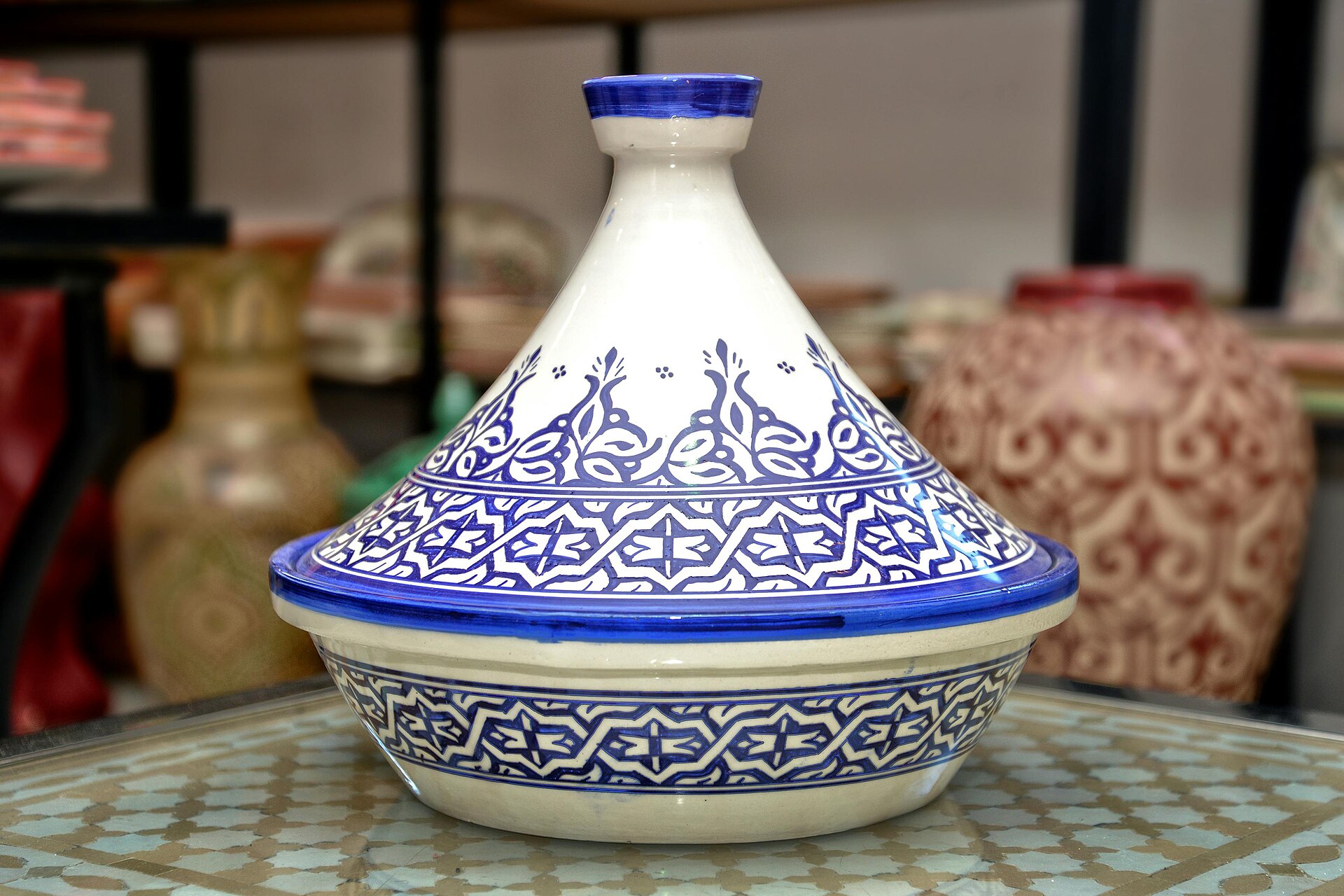
Cooperative Imik Simik publishes a three-hour proposition involving tagine and traditional bread with local women as teachers. This creates a visible practice loop and a potential direct-benefit route. Registration, teacher identity, exact kitchen, compensation, food controls and current dates remain unverified.
Cooking with Laila remains a discovery lead because its direct page returned no usable body during research. It is shown only as a transparent investigation profile, with no assumed menu, teacher or availability.
Hospitality time is not cooking time
Ask which steps each learner performs, how correction works and what method can be repeated at home. Tea, conversation and eating may be meaningful, but they are not active preparation time.
The class must disclose ingredients, allergens, cross-contact, water, handwashing, heat and knife boundaries. Ingredients, kitchen, venue and inclusions must be explicitly alcohol-free.
Walking needs a live access check
Current visitor sources disagree about admission and crossing details. Do not build an itinerary around a fixed fee, opening hour or river route without checking again. Weather, rain, heat and conservation work can change the safe public path.
A learning walk should identify the guide, start, duration, uneven surfaces, steps, shade and mobility alternative. It must distinguish public circulation from residential, sacred, cemetery and permission-only spaces.
Photography needs consent and critique
National photo workshops include Aït Benhaddou at dawn or sunset, but a scheduled stop does not prove a local course. A qualifying session needs a named teacher, place-specific brief, shooting permissions, individual guidance, image selection and critique.
Identifiable residents, homes, work and private terraces require explicit permission. Public circulation is not blanket consent, and staged people or animals require truthful disclosure and payment or welfare evidence.
Tourism benefit is part of quality
Conservation work at Aït Benhaddou has treated community participation and distribution of tourism benefit as material issues. A provider should disclose who teaches, who receives payment, who controls images and how residents can refuse access or participation.
“Local” and “authentic” are not evidence. Named people, consent, direct benefit and a teachable sequence are.
What does not qualify here
Broad craft history does not prove a current local workshop. Film-location access does not create filmmaking tuition. A conservation project does not create a visitor restoration class. Painting was not supported by a grounded teacher or format. These subjects are excluded until direct evidence changes.
Return to Morocco, compare the separate film-city hub at Ouarzazate, or use the learning-holiday definition to test an offer.
Enquire with the useful details
Tell GoLearnTo what you want to learn, your dates, level, group, preferred language and access or dietary needs. An enquiry requests verification or an introduction; it does not confirm booking, availability, access, safety or suitability.
Evidence
Selected references
Official and institutional references used for place, heritage or practical context. Commercial operators and marketplaces are kept in our private research ledger rather than promoted here. Reviewed 14 August 2026.
- UNESCO World Heritage Centre
- UK Government travel advice
 Editorial contextLearn in Aït Benhaddou, Morocco