Fes textile learning can begin with a mini loom, a drop spindle or a natural-dye bath. The best choice depends on whether you want to understand structure, fibre or colour.
Three different learning routes
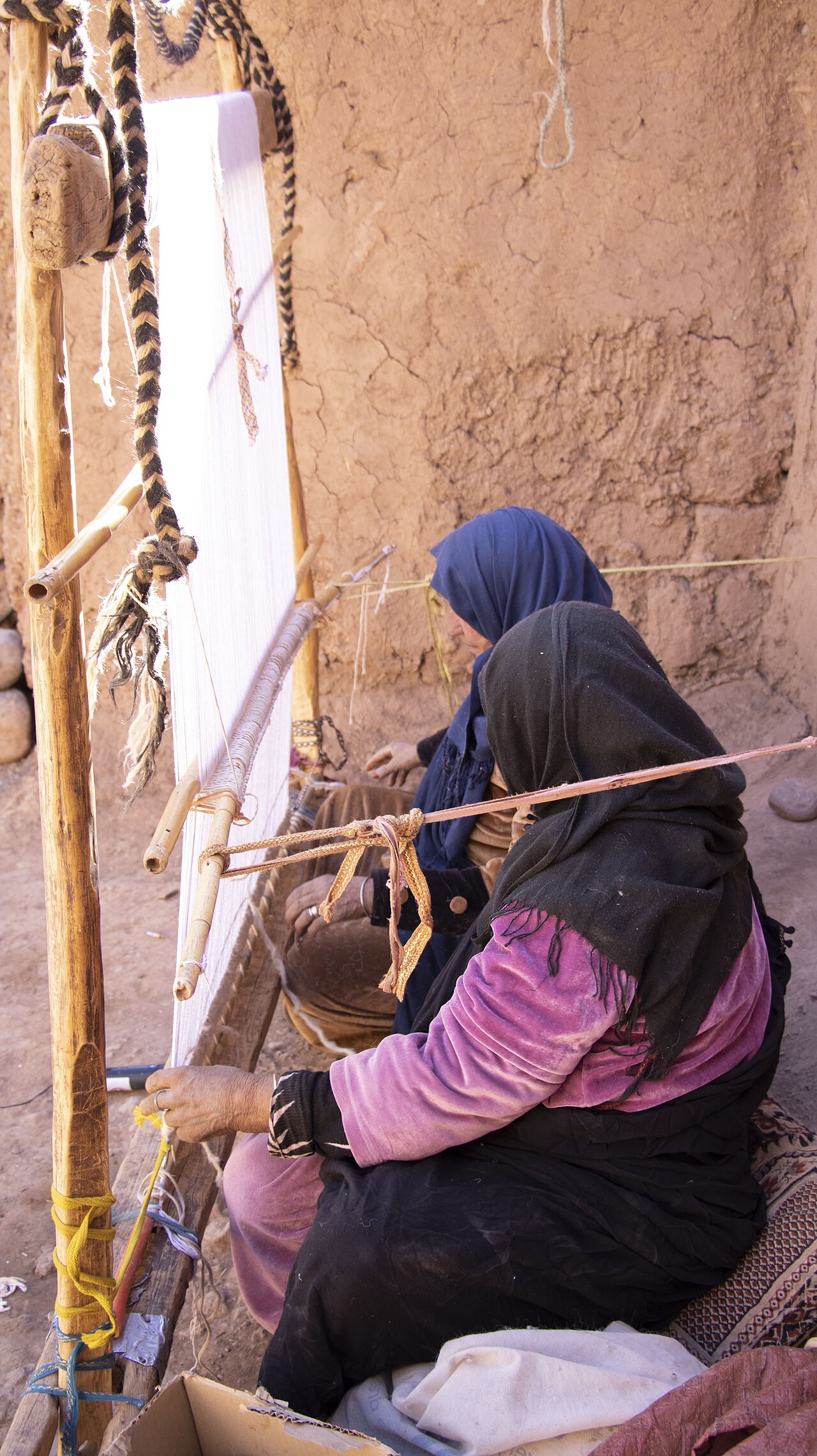
- Weaving: plan a simple design, choose colours, set or use a prepared loom, build rows and correct tension.
- Wool spinning: prepare fibre, control a drop spindle and produce a first length of yarn.
- Natural dye: identify dye material, prepare fibre, manage a dye bath and discuss colour variation or colourfastness.
A rug-shopping visit may explain motifs and regional traditions, but it is not a weaving lesson unless the learner works at a loom with instruction.
What makes a short workshop useful?
The task must fit the time. A beginner can make a small woven sample in several hours; a room-sized carpet cannot be produced during a holiday workshop. The retained object should prove the practised sequence, not disguise how much work the artisan completed beforehand.
Anou’s current introductory weaving outline includes sketching a design, choosing wool colours, working on a mini loom and receiving progress checks from an artisan leader. Its natural-dye and wool-spinning formats expose similarly distinct stages. That is why GoLearnTo treats them as separate skills within the same Fes textile cluster.
Rug and cooperative claims
Ask who owns or governs the workshop, who sets prices and how teaching fees reach the artisan. “Women’s cooperative” should not be used as a trust shortcut without a named organisation and current evidence.
Motif meanings also require care. A seller, guide or website may offer one interpretation that is not universal across regions, families and makers. Ask the artisan what they wish to explain rather than turning every pattern into a fixed symbol dictionary.
Material and access questions
Wool and dye materials can affect people with allergies or sensitivities. Natural does not automatically mean harmless. Ask about ventilation, gloves, heat, mordants and safe handling. Medina access, stairs and narrow workshop layouts should be confirmed for the exact venue.
Before you enquire
- Which skill— weaving, spinning or dye—owns most of the contact time?
- Who is the assigned artisan teacher?
- How many learners share one teacher?
- Is the loom prepared in advance, and which setup stages are explained?
- How does correction work when tension or pattern goes wrong?
- What materials, dyes and protective controls are used?
- May the learner keep the sample, yarn or dyed fibre?
- Is the venue and complete session explicitly alcohol-free?
- What are the access, insurance, price and cancellation terms?
Return to the Fes learning hub, compare the broader Fes craft map, or read the carpet-weaving guide.
Evidence
Selected references
Official and institutional references used for place, heritage or practical context. Commercial operators and marketplaces are kept in our private research ledger rather than promoted here. Reviewed 14 August 2026.
- UNESCO World Heritage Centre

 Editorial contextLearn in Fes, Morocco