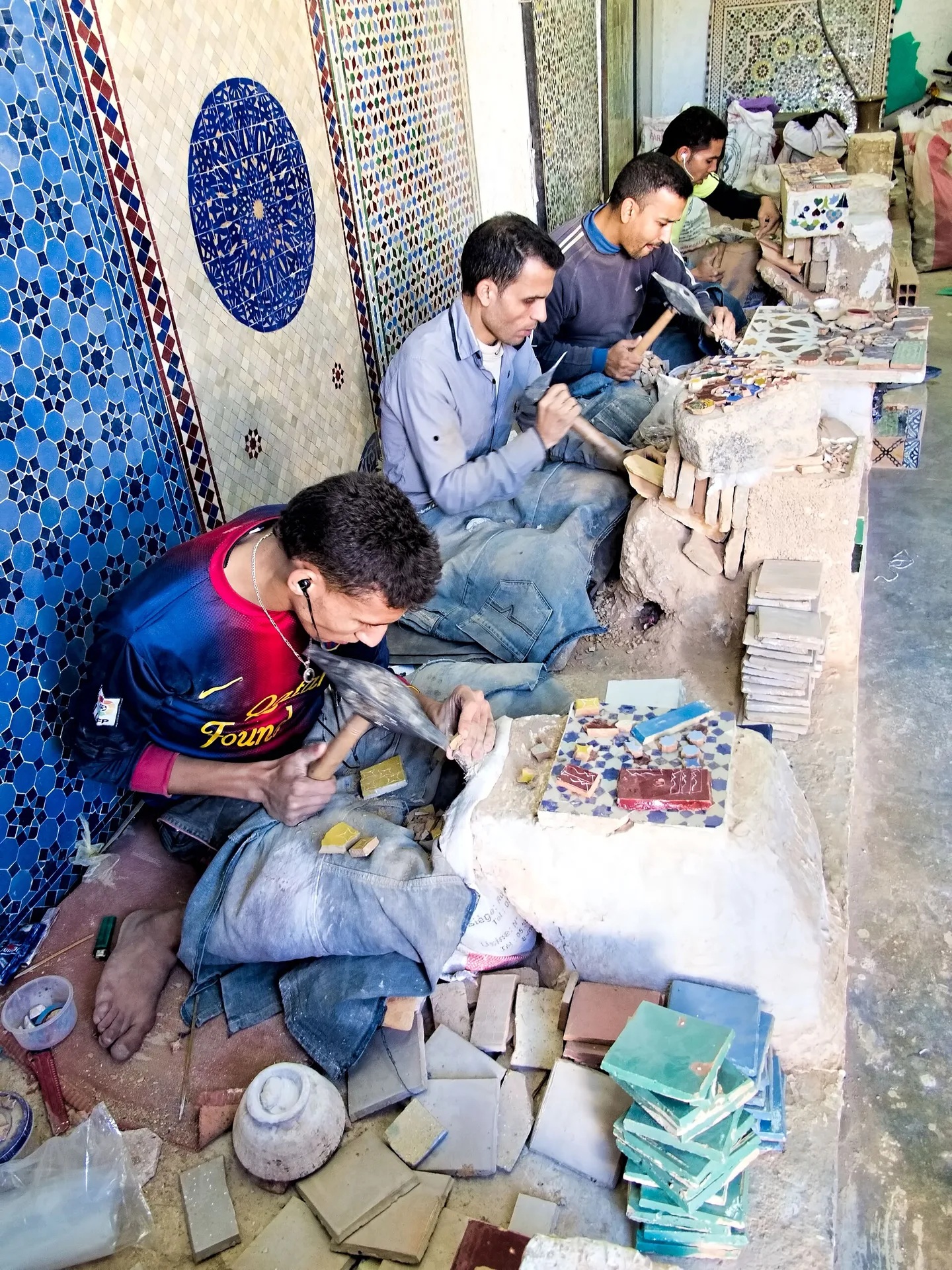

Zellige is one of those crafts that looks effortless only after somebody has spent years making it look effortless. A square glazed tile is cut into tiny geometric pieces, then rebuilt into a pattern—often face down, so the finished design stays hidden until the panel is turned.
If you want to try it in Fes, the important question is not simply “Do you offer zellige?” Ask which stage your hands will actually touch.
The quick decision map
| If you want to… | Look for… | Watch out for… |
|---|---|---|
| Understand the full craft | A workshop that explains clay, firing, glazing, cutting and assembly | A showroom talk presented as a class |
| Make a small mosaic | Pattern planning and supervised assembly with pre-cut pieces | Claims that two hours covers the whole production chain |
| Try hand cutting | A stable bench, eye and hand protection, close supervision and clear age limits | Unsupervised hammer and chisel use |
| Paint a tile | A pottery-painting class that says exactly that | Calling painted square tiles “zellige making” |
| Take something home | A confirmed output, drying time and collection or shipping plan | Discovering at the end that wet backing cannot travel |
Zellige in plain English
Zellige is mosaic tilework made from individually shaped pieces called tesserae. The craft appears across Moroccan fountains, courtyards, floors, walls and architectural details. Fes remains one of its most important production centres, with a long pottery tradition and local clay supply.
The word can refer to the small glazed elements and to the finished mosaic surface. That is why workshop descriptions can become confusing. A class may involve cutting, arranging, painting, touring or simply watching. These are all different experiences.
From clay to geometric pattern
The long production chain starts before the colourful pieces reach the workbench:
- Clay is prepared and moulded into tiles.
- The tiles are dried and fired.
- A glaze is applied and fired again.
- Finished tiles are marked and hand-cut into geometric forms.
- The tesserae are arranged face down to build the pattern.
- The panel is backed, cured and eventually turned to reveal the design.
Moroccan apprenticeship documents recognise zelligier as a distinct craft occupation. A visitor workshop can open a useful door into the process; it is not a replacement for apprenticeship. That distinction gives more respect to the craft, not less pleasure to the learner.
What can you genuinely learn in two hours?
A thoughtful short workshop can teach you how a pattern is planned, why each shape matters and how pre-cut tesserae fit together. You may assemble a coaster or small panel, receive correction and leave with a much sharper eye for the zellige around Fes.
What it cannot do is take raw clay through drying, two firings, glazing, cutting and final installation before lunch. If the pieces are prepared in advance, that is perfectly reasonable. The provider should simply say so.
Hand cutting is a deeper and more demanding stage than assembly. It also adds sharp fragments, dust and tool risk. A beginner session needs close supervision, a stable work surface and appropriate protection.
Assembly, cutting, painting or a visit?
Choose the format before choosing the provider:
- Mosaic assembly: you work with pre-cut pieces and learn pattern logic.
- Cutting practice: you shape fired tile with a hammer and chisel under supervision.
- Pottery painting: you decorate a tile or vessel; useful and enjoyable, but not the same process.
- Workshop or factory visit: you observe production and ask questions without a promised making session.
- Multi-day course: you have more time for repetition, correction and a larger outcome.
None is automatically “better”. The good option is the one described honestly and matched to what you want to learn.
Safety, children and access
Ask where the practical work happens. Traditional workshops may use low benches, uneven floors and narrow approaches. A general promise of accessibility is not enough; confirm the route, work height, seating, toilets and transfer point for the actual site.
For children, ask about minimum age, tool substitution, instructor ratio and whether adults must participate. A painting or pre-cut assembly session may suit younger learners better than cutting fired ceramic.
Glaze, dust and firing claims also need care. Visitors should not be invited to handle unknown materials or use tools without a clear safety method.
Current Fes leads: promising, but not all the same
Several current pages describe zellige-related experiences in Fes. They are useful research leads, not interchangeable products:
- Fes Pottery Art describes separate pottery, painting and zellige formats.
- A marketplace listing describes a two-hour session centred on arranging hand-cut pieces and sealing a small mosaic.
- Palais de Fès advertises pottery, painting and zellige within one short masterclass.
- Factory visits show the production environment but do not become classes unless supervised participant practice is included.
GoLearnTo keeps these profiles on HOLD until the exact teacher, participant stages, tools, group size, current price and take-home arrangements are confirmed. A lively page with many photographs is not the same thing as a verified lesson. Khalliha ʿla Allah is a fine attitude for many moments in Morocco; sharp tile fragments are not one of them.
Geometry before the hammer
A beginner session improves when the teacher explains the unit and repeat before cutting begins. Trace the outline, mark the centre or symmetry line and test the arrangement with paper or prepared pieces. This makes the final pattern a set of decisions rather than a colourful puzzle solved by the artisan after you leave.
Ask whether the design is traditional to the workshop, adapted for learners or created as a contemporary exercise. A small coaster-sized composition can teach proportion, rotation and negative space more clearly than a larger panel completed mostly by staff. Photograph your dry layout—with permission—so you remember the sequence if pieces move during assembly.
The useful goal is not speed. It is to see how one accurately shaped piece affects every neighbour around it, then make a better second piece.
Questions worth sending before you book
Ask the provider:
- Will I cut tile, assemble pre-cut pieces, paint or only observe?
- Who teaches, and how many learners share one instructor?
- Which stages are prepared before I arrive?
- What will I complete myself?
- Can I take the piece the same day?
- If not, is collection or shipping available?
- Which tools and protective equipment are used?
- What are the age limits and access conditions?
- Which language will the teacher use?
- Is the workshop fully alcohol-free?
These questions are not fussy. They are how you find the session that suits you—and how a serious teacher sees that you are genuinely interested.
Build a richer Fes learning day
Start with the complete Fes learning guide. Compare a practical session with pottery and zellige workshops, then look at how the city’s material culture connects with leather craft, weaving, metal engraving and Arabic calligraphy.
If you want the vocabulary before the workshop, read the GoLearnTo entries for zellige and kiln firing. Return to the Morocco learning hub when you want to compare Fes with Tetouan, Marrakech or another craft base.
Enquire with the useful details
Tell GoLearnTo whether you want assembly, cutting, painting or a longer course. Add your dates, group size, ages, preferred language, mobility needs and the object you hope to make. GoLearnTo can then ask a much better question than “Is the workshop available?”
Evidence
Selected references
Official and institutional references used for place, heritage or practical context. Commercial operators and marketplaces are kept in our private research ledger rather than promoted here. Reviewed 14 August 2026.